
6 min read
The Bohinj car-train: how the Alps get crossed without the long way round
A train that carries your car through a 6.3 km tunnel under the Julian Alps between Bohinjska Bistrica and Most na Soči – what it costs, how long it takes, and whether it is worth doing over the Vršič Pass.
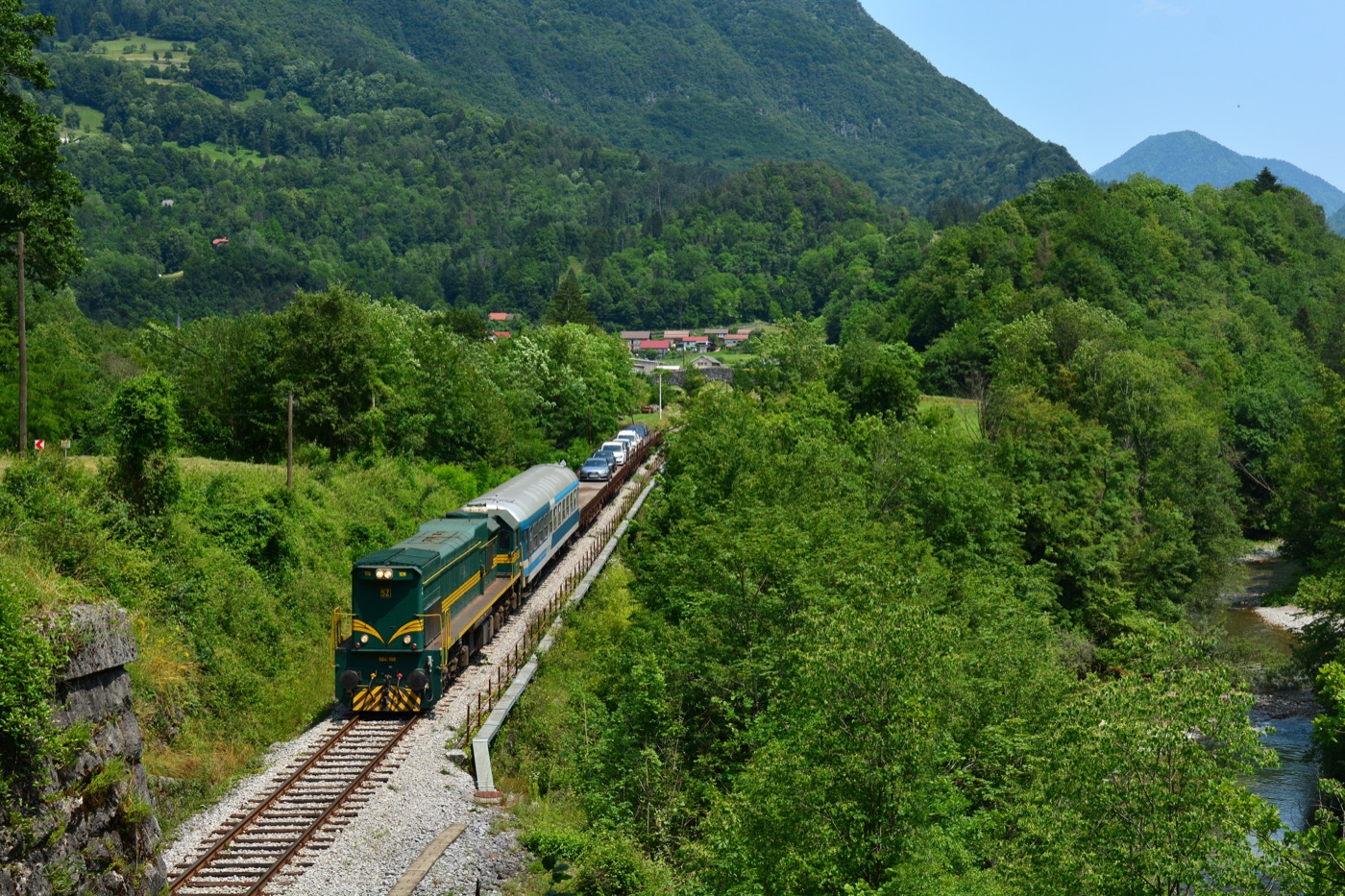
Between the Bohinj valley and the Soča valley there is a wall of the Julian Alps with exactly two ways through: the Vršič Pass, fifty hairpin bends climbing to 1,611 metres and closed by snow roughly from November to May, or a train. The second option surprises almost everyone who hears about it for the first time: at Bohinjska Bistrica, cars are loaded onto flatbed wagons and carried straight through the mountain in a 6,327-metre rail tunnel, built in 1906 and still the only way across this stretch of mountains once the pass is shut.
Why a train carries cars at all
The Bohinj tunnel was dug for the Transalpina railway connecting Trieste to Austria's rail network, finished in 1906 under Austro-Hungarian rule, long before anyone planned to drive a car through it. The valley walls on either side are too steep for a road to have ever been cut alongside it, so when cars became the thing people needed to move, the railway started carrying them rather than a new road getting built from scratch. It reads less like a tourist novelty than the only year-round way through, snow or no snow.
How it actually works
At the Bohinjska Bistrica station, cars drive up a ramp onto open flatbed wagons, one after another, nose to tail. Nobody needs to get out: drivers and passengers usually stay in the car for the ride, though you can step onto the small platform between wagons if you would rather watch the tunnel walls go by. The crossing itself takes about ten minutes at a crawl, surfacing at Most na Soči on the other side, in the Soča valley proper.
Timetable and cost
Trains run through the day in both directions, more often in summer than in the shoulder seasons, and the whole thing – loading, the tunnel, unloading – takes under half an hour door to door. The fare is charged per car regardless of how many passengers are inside, and it is cheap by the standards of anything else in this guide: well under the cost of the fuel the long way round would use. Slovenian Railways publishes the current timetable and fare on its own site, worth checking the day before, since the schedule thins out noticeably outside the summer months.
Worth doing, or just a curiosity
If the plan is simply to get from Bohinj to the Soča valley, the train wins outright once the Vršič Pass closes for winter, and it is faster than the pass even in summer. If the plan is to see the Alps rather than just cross them, the pass is the point – fifty hairpins and a view from 1,611 metres that the train, underground the whole way, cannot offer at any price. The honest answer is to take the pass in good weather and keep the train in mind as the fallback, not the other way round.
| From Ljubljana to | Distance | Drive | From |
|---|---|---|---|
| Bohinjska Bistrica | 75 km | 1 h 20 min | €90 |
That figure is for the drive to the loading station itself. The train fare for the car is separate and paid at Bohinjska Bistrica on the day; we can arrange the whole crossing as a day hire, car and driver included for the time it takes.
Need a car for this trip?
Fixed price agreed before you travel, tolls and parking included, and the owner behind the wheel.
Get a price